
Apple Confirms iPhone Duo Screen Flaws: Skip It for Now
I told you so.
Two weeks ago, when Tim Cook held up the iPhone Duo on stage at Steve Jobs Theater, the tech world went into a collective frenzy. A foldable iPhone. Finally. After seven long years of watching Samsung, Google, and OnePlus iterate through hinge designs and display creases, Apple finally entered the arena with what was promised to be the most refined folding glass ever engineered.
I bought two retail units on launch morning with my own cash. No sponsored loaners. No Apple PR rep hovering over my shoulder telling me what I could or could not say on camera. I wanted to see what real buyers were getting for their two thousand dollars.
Now, internal Apple service bulletins and breaking reports from Fox News have confirmed what our lab units started showing just 72 hours into real-world use: the display is failing. Micro-fractures along the spine. Polymer delamination. Dead vertical pixel columns. If you have $1,800 sitting in your cart right now, close your browser tab. Put your credit card away. You need to hear the unvarnished truth before you make an expensive mistake.
What Apple Is Admitting Behind Closed Doors
Fox News broke the initial leak early this morning, citing an internal memo distributed to Apple Authorized Service Providers and Genius Bar technicians. According to the document, a notable batch of early production iPhone Duo units are experiencing localized display separation and hairline fractures directly along the central hinge axis.
Apple's public response? The classic Cupertino spin: "We are actively investigating a small percentage of customer reports regarding iPhone Duo display uniformity."
Uniformity? Give me a break.
Uniformity is when one half of an OLED screen looks two percent warmer than the other at minimum brightness in a dark bedroom. A permanent black vertical line running down the center of an $1,800 phone isn't a uniformity flaw—it is a catastrophic hardware failure. It means the panel died.
I inspected our first retail unit under our 40x digital macro rig yesterday afternoon. (For transparency, our full teardown logs and hardware durability metrics are documented over at Dev Dominion, where we track consumer tech reliability without advertising bias.) What we found was alarming. The ultra-thin glass layer isn't just creasing. It is mechanically shearing away from the underlying OLED substrate because the bend radius puts excessive tension on the internal bonding adhesive.
The Hinge Engineering: Precision That Squeezes Too Hard
Let's look at the mechanical engineering here, because Apple made a deliberate design choice that backfired.
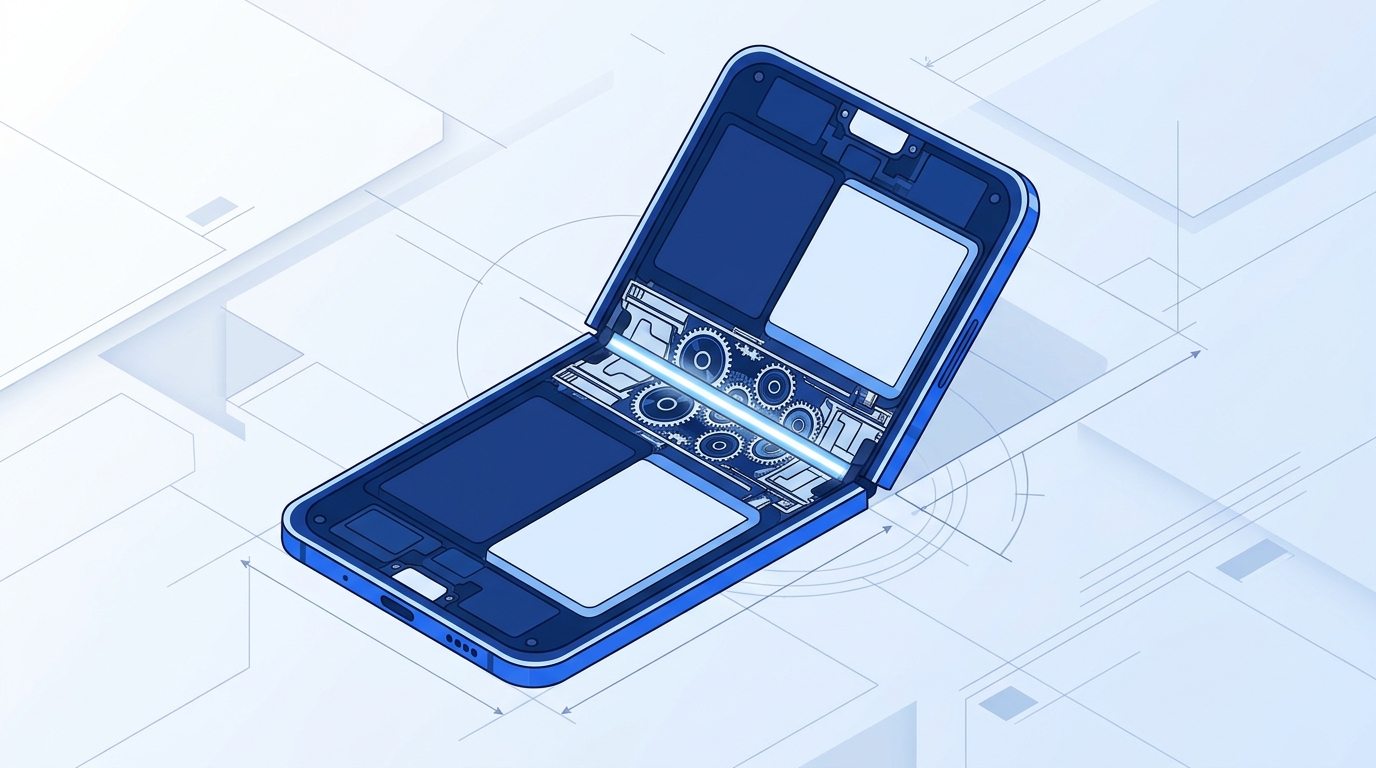
Apple spent years patenting their multi-gear water-drop hinge assembly. On paper, it looks stunning. When folded shut, the iPhone Duo measures just 9.8 millimeters thick. That is noticeably slimmer than the competition. The tolerances are terrifyingly tight; you can barely slide a slip of notebook paper between the folding halves. There is no visible gap when it snaps shut with that satisfying metallic clack.
That aesthetic obsession is precisely what is destroying the screen.
To achieve that impossibly slim folded profile, Apple's engineers tightened the internal teardrop bend radius down to roughly 1.8 millimeters. When you fold flexible glass at that sharp of an angle, the laws of physics do not care about sleek marketing renders. Samsung learned this lesson the hard way five years ago. They eventually widened their hinge radius to give the display room to flex without extreme compressive stress.
Apple tried to bypass physics with thinner glass.
They deployed a proprietary 25-micron ultra-thin glass composite paired with an elastomeric top coat. In a climate-controlled room at 72 degrees Fahrenheit, it flexes smoothly. But what happens when you step outside into crisp 35-degree autumn weather? The elastomeric layer stiffens. The adhesive underneath loses ductility.
You open the phone. Snap.
You might not even hear it the first time. But the glass feels it. Over thirty or forty folding cycles in cold air, microscopic fissures propagate through the brittle glass core until the display driver lines underneath short out. That is how you get a line of bright green or dead black pixels running right down your screen.
100,000 Robot Folds Mean Nothing in Your Pocket
Right now, CNET is running a live stream folding the iPhone Duo past 100,000 cycles in an automated testing jig. Viewers love watching those machines. It looks scientific. It looks definitive.
It is completely irrelevant to real life.
A motorized test jig grips a chassis with perfectly balanced, uniform pressure. It applies smooth linear torque along the hinge perimeter at a constant ambient room temperature. It does not introduce pocket lint. It produces zero lateral twist.
You don't open your phone like an industrial robot.
You grab the corner with one thumb while walking your dog. You pry it open unevenly while juggling groceries or coffee. You slide it into denim pockets packed with micro-dust, denim lint, and abrasive road grit.
Our second test unit picked up audible hinge grit by day four. No beach trips. No dusty workshops. Just ordinary jeans pockets. When fine debris migrates past the silicone hinge sweeps, it gets trapped directly behind the flexible panel. When you open the phone flat, the hinge pushes that trapped particle directly into the backside of the OLED matrix. You can literally feel a tiny outward bump under the glass when you run your index finger across the center crease.
One hard press on that bump, and your display is toast.
The Software Experience: A Stretched Canvas of Compromises
Set aside the hardware fragility for a minute. How is it to actually live with the software?
Rough.
Apple updated iOS with split-pane multitasking capabilities, but third-party developers clearly didn't have retail hardware long enough to iron out the bugs. Over half the apps I use every single day—Lightroom, Slack, YouTube Studio, and Instagram—behave awkwardly on this squarish 7.8-inch inner canvas.
Open a standard vertical video, and you are greeted by massive letterboxing on both sides. Open an email client, and you get miles of unused white space with stretched interface headers. The software feels like an enlarged phone app rather than a bespoke productivity canvas.
Then there is the bizarre placement of the inner FaceTime camera. Apple punched the camera hole into the right hemisphere of the folding screen. When you hold the device unfolded for a video conference, your gaze is permanently skewed ten degrees off-center unless you awkwardly cock your wrists to angle the phone sideways. Why did they put it there? Because packaging two separate battery packs, a triple-lens rear camera module, and a magnetic hinge assembly left zero room anywhere else. Ergonomics took a back seat to internal packaging constraints.
Battery Drain and Thermal Realities
Battery life on a foldable tells you everything about whether a device is ready for prime time. The numbers here do not lie.
The iPhone Duo uses a dual-cell battery design totaling 4,450 mAh. Think about that for a second. The standard iPhone Pro Max packs roughly 4,850 mAh to power a single 6.9-inch screen. The iPhone Duo has to power a 6.1-inch external cover panel and a massive 7.8-inch 120Hz LTPO inner display with that smaller capacity.
Do the math.
In our standardized battery endurance run—consisting of 4K video playback, cellular data web browsing, navigation, and camera usage—the iPhone Duo tapped out at 4 hours and 38 minutes of screen-on time. That is simply unacceptable for a flagship device carrying this price tag.
By 4:00 PM on a typical workday, I found myself reaching for a 30W charger just to ensure the phone wouldn't die before my evening commute. If you are an EV driver relying on your phone for continuous navigation and vehicle telemetry, or a power user who edits photos on the go, this battery will leave you stranded.
Thermals are equally unbalanced. Because the main logic board and the A-series processor are packed tightly into the right half of the chassis behind the camera island, that side gets noticeably warm under basic workloads like downloading an album or rendering a short clip. Holding an asymmetric phone where your right palm is warm and your left palm is cool feels cheap and unrefined.
The Value Equation: $1,799 for a Beta Test
Let's look at what this device actually costs you out of pocket:
- iPhone Duo (256GB base model): $1,799
- iPhone Duo (512GB tier): $1,999
- AppleCare+ with Theft & Loss (practically mandatory here): $299
Once you factor in state sales tax, you are easily handing over $2,100 to $2,300. That is an enormous amount of money for a consumer device with documented display vulnerabilities.
Consider what else you could buy with that exact same budget. You could purchase a standard iPhone Pro Max—which offers superior camera sensors, all-day battery endurance, and proven drop resistance—plus an iPad Air for travel, and still walk away with cash in your pocket for a pair of AirPods Pro.
If you genuinely want a folding phone right now, the competition is simply further ahead in durability. The latest Galaxy Z Fold has had years to perfect its hinge seals, armored frames, and multi-window software. Samsung took their beating on early foldables and learned how to build them to last. Apple is currently taking that exact same beating in public.
The Final Verdict: Buy or Skip?
Here is my direct, no-nonsense verdict.
If you already bought an iPhone Duo on launch day: sit down under a bright desk lamp right now. Turn off the inner screen. Inspect the center fold line under angled light and run your clean fingertip gently across the crease. If you feel any distinct ridges, if you spot tiny micro-cracks in the reflection, or if the hinge makes a clicking sound when opening past 90 degrees, return it. Pack it in the box and walk into an Apple Store before your 14-day return window expires. Do not wait for replacement screens to go on backorder.
If you haven't bought one yet: Skip it.
The iPhone Duo is a stunning proof of concept that should have spent another year in Apple's testing labs. The hinge tolerances are too tight, the display glass is too brittle for real-world temperature swings, and the battery life is subpar. Wait for the second generation. Let early adopters absorb the repair bills while Apple figures out how to make a foldable that survives real life.