Rivian R2 vs. Tesla Model Y: Why Horsepower Won't Save Elon
The 650-Horsepower Distraction
Here is an uncomfortable fact for automotive marketing executives: nobody cares about sub-three-second zero-to-sixty times anymore. Seriously. Launching an electric SUV so hard that your coffee splatters the headliner is fun twice. After that, you are just commuting. You want to know if the suspension smacks your kidneys over highway expansion joints, whether the rear liftgate leaks in a car wash, and if you can plug in without wrestling a three-foot charging cable like an angry anaconda.
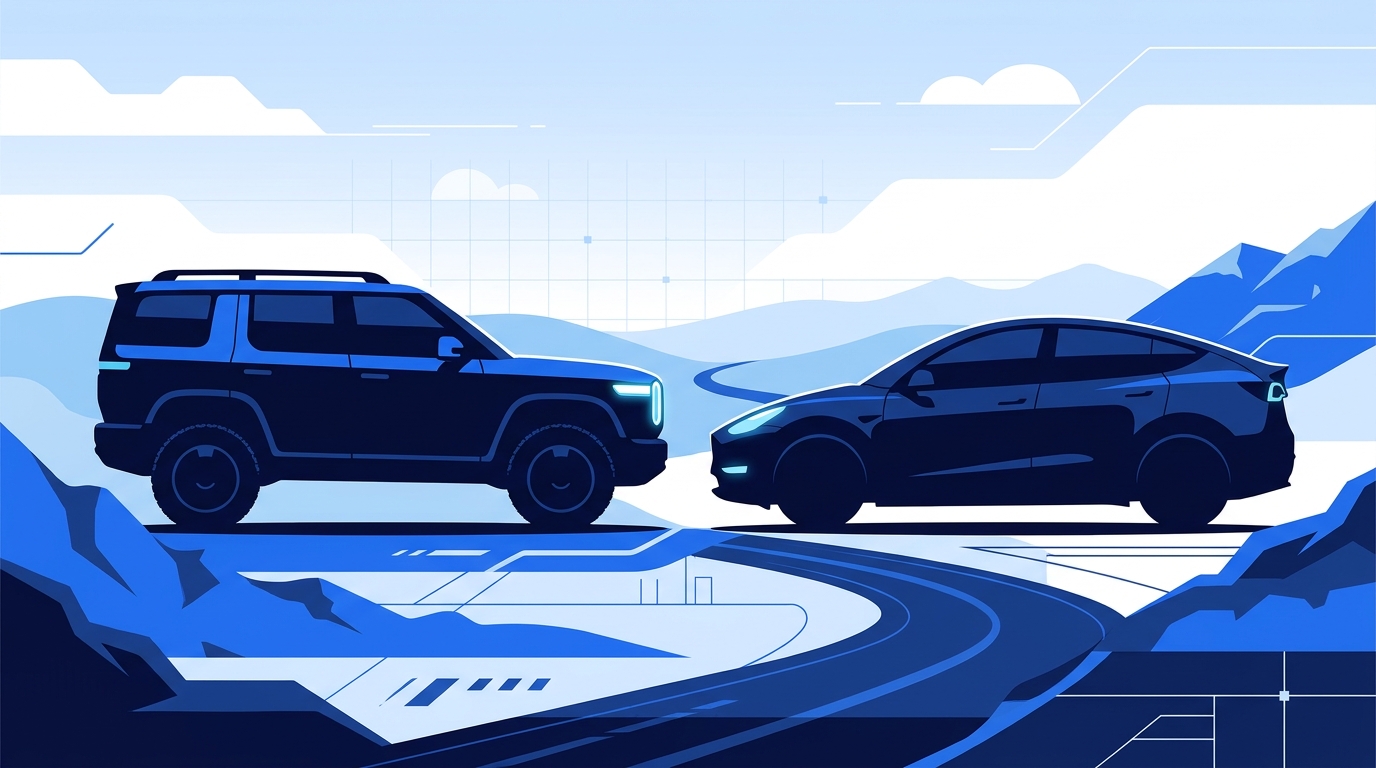
Car and Driver just pitted the upcoming Rivian R2 against the reigning electric crossover heavyweight, the Tesla Model Y, in a head-to-head horsepower showdown. The dyno numbers and quarter-mile traps look dramatic on paper. Rivian claims their tri-motor R2 will deliver well over 650 horsepower, easily rivaling the Model Y Performance's 455-horsepower dual-motor punch. But I spent the past week dissecting the mechanical underpinnings, suspension architecture, and cabin ergonomics of both platforms. Spec-sheet bragging rights have blinded buyers to what actually matters once the honeymoon period ends.
Horsepower is cheap in electric vehicles. Building a durable, quiet, daily-drivable crossover for forty-five grand? That is brutally difficult.
Off the Line: Straight-Line Speed Is Cheap
Straight-line speed in an EV is essentially a software slider and thermal headroom. Tesla figured out that formula a decade ago. The Model Y Performance pins you into your seat with immediate, violent torque delivery. It rips from zero to sixty in 3.5 seconds without breaking traction. The Rivian R2, running on its top-tier tri-motor layout (two motors rear, one front), targets zero to sixty in roughly 3.0 seconds flat.
Is the R2 quicker? Yes. Does it matter on your morning run to Target? Not even slightly.
What does matter is how both drivetrains handle thermal heat soak and torque modulation. During aggressive mountain passes and sustained high-load pulls, Tesla's silicon-carbide inverters begin throttling output to protect battery cells. Rivian took notes. Their in-house 'Enduro' drive units use oil-cooled stators designed specifically to sustain sustained high-torque demands without premature thermal clipping. If you plan on towing a small camper or climbing steep fire roads, Rivian's mechanical torque vectoring on the rear axle destroys Tesla's brake-actuated fake torque vectoring. One works mechanically through independent motors; the other cooks your rear brake pads while trying to simulate an open differential lock.
The Chassis Test: Broken Pavement Tells the Truth
This is where the Model Y falls flat on its face. We have tested every iteration of the Model Y since 2020. Even with Tesla's 'comfort suspension' damper update in late 2022, the Model Y rides with the harshness of a stripped-out track car on worn bump stops. Hit an uneven bridge seam at 70 mph and the entire unibody shudder reverberates right through the seat rails. The cabin rumbles.
Rivian took an entirely different mechanical approach with the R2. Instead of standard stamped-steel arms and stiff steel springs tuned specifically to prop up heavy battery weight, the R2 borrows engineering lessons from the larger R1S. It uses a high-articulation double-wishbone front suspension and an independent multi-link rear setup with custom-valved dampers.
- Chassis Compliance: The R2 absorbs secondary road vibrations that send tremors through the Model Y's glass roof.
- Ground Clearance: Rivian sits at 9.8 inches of usable clearance compared to the Model Y's meager 6.6 inches.
- Suspension Noise: Tesla's subframe bushings transfer low-frequency tire hum straight into the cabin volume. Rivian isolated the R2 subframes with heavy elastomeric damping rings.
If you live in a city with cracked asphalt, frost heaves, or gravel roads, the R2 will feel like an absolute sanctuary compared to the Model Y's jarring rebound tune. That alone will win over thousands of prospective buyers who are sick of getting jostled on their daily commute.
Interior Feel and Usability: Knobs, Screens, and Creaks
Step inside both cabins and you immediately spot two opposing design philosophies. Tesla calls their setup 'minimalist.' I call it cost-cutting dressed up as innovation. Eliminating turn signal stalks in favor of haptic capacitive buttons on the steering wheel remains one of the worst automotive decisions of the past decade. Fumbling for a tiny button while turning the wheel through a roundabout is flat-out infuriating.
Rivian did not take the bait. While the R2 still centers driver controls around a large landscape touchscreen, they kept critical physical interactions tactile. The steering wheel features two prominent, heavy-weight haptic scroll wheels with actual physical feedback. You feel distinct clicks. You do not have to pull your eyes off the road to toggle basic settings.
Then there is interior ventilation and packaging. The R2 features roll-down rear quarter glass and a rear liftgate window that drops completely into the tailgate. If you carry surfboards, lumber, or just want open-air cabin flow without buffeting, it is brilliant design work. Tesla's rear hatch glass is fixed shut. The Model Y's expansive glass roof also acts as a massive thermal greenhouse in midsummer. While Rivian uses electrochromic dimming tech on upper R2 trims, Tesla still expects owners to buy clip-in mesh sunshades from third-party Amazon sellers just to prevent head sweat.
Over at our hardware review platform running on Dev Dominion, our audience constantly asks us about long-term creaks and rattles. Tesla's frameless door windows and lightweight plastic trim clips are notorious for developing mystery squeaks after twelve months. The pre-production R2 units showcase thick acoustic laminated glass all around and denser rubber weather stripping. The door shuts with a reassuring, heavy thud.
The Charging Port Blunder and Supercharger Reality
Both vehicles feature native NACS (North American Charging Standard) charge ports out of the box. That means seamless plug-and-charge access to Tesla's industry-leading Supercharger network without fiddling with bulky CCS adapters. Game over, right? Not so fast.
Port placement creates an immediate practical nightmare. Tesla vehicles place their NACS port on the driver-side rear corner. Rivian, for reasons that defy spatial logic, placed the R2's NACS port on the passenger-side rear corner. Here is why that matters: V2 and V3 Tesla Supercharger cables are notoriously short—less than six feet long. To plug in a Rivian R2 at a standard V3 Supercharger, you either have to park nose-in awkwardly over the parking curb, or back in and hog the adjacent parking stall's charger.
Tesla is rolling out V4 Supercharger posts with extended ten-foot cables, but tens of thousands of existing V3 stalls will remain short-corded for years. Until those cables get updated, pulling an R2 into a crowded holiday Supercharger lot is going to cause awkward glares and parking stall choreography. Keep that in mind if road-tripping constitutes a large percentage of your weekly mileage.
Battery Architecture: 4695 Cells vs. 4680 Structural Blocks
Under the floorboards sits the single most expensive component of both vehicles: the battery pack. Tesla uses a structural pack design in the Model Y, integrating 4680 cylindrical cells directly into the floor pan as a stressed member. It reduces weight and manufacturing complexity, but it has drawbacks. Independent repair shops have documented that replacing individual damaged cells or modules in a structural Tesla pack is virtually impossible. A catastrophic pack failure out of warranty means scrapping the entire bottom half of the vehicle.
Rivian is pioneering a larger 4695 cylindrical cell format for the R2 platform. These cells stand 95 millimeters tall—fifteen millimeters taller than Tesla's 4680 design. That extra volumetric space allows for higher energy density per cell, lower cell count overall, and superior thermal dissipation through the cooling plate manifold.
- Charging Curve Stability: The R2 is engineered to sustain a 10% to 80% charge in less than 30 minutes, holding over 180 kW well past 50% state-of-charge.
- Cold-Weather Resilience: Rivian's new heat pump loop scavenges waste heat from the drive units, inverter board, and cabin exhaust simultaneously, preventing range collapse in sub-zero climates.
- Safety and Serviceability: The R2 pack housing features replaceable module arrays instead of a solid epoxy-potted brick.
Tesla's charging curve drops like a rock after 45% state of charge. If Rivian delivers on its thermal modeling promises, the R2 will out-charge the Model Y at public DC fast chargers where real road-trip time is won or lost.
Vision-Only Autopilot vs. Rivian Autonomous Platform
We need to talk honestly about driver assistance. Elon Musk stripped ultrasonic sensors and millimeter-wave radar from the Model Y years ago, betting the company on 'Tesla Vision.' The result? Phantom braking on undivided two-lane highways, degraded performance in heavy rain or blinding sunrise glare, and a windshield-wiper algorithm driven by camera software that turns on when there is not a single drop of water in sight.
Rivian rejected that camera-only ideology. The R2 carries an integrated sensor cluster that includes eleven cameras, five radar units (including an ultra-high-resolution front imaging radar), and an interior driver-monitoring camera. Combining optical inputs with radar gives the R2 cross-validation. When fog or salt spray blinds an optical camera lens, radar still measures closing distance to the vehicle ahead with millimeter precision.
Tesla's Full Self-Driving software has made incredible strides in navigate-on-city-streets navigation, but you must babysit it constantly. Rivian's driver assistance system is less ambitious on paper—it focuses purely on bulletproof Level 2+ highway hands-free driving—yet it executes that narrower job with far fewer panic interventions. For long-distance cruising, predictable highway assist beats erratic robo-taxi experiments every single day of the week.
Real Value, Delivery Reality, and the Ownership Math
Let us look at pricing and availability. This is where Tesla holds its biggest advantage. You can buy a Tesla Model Y right now, pick it up next weekend, and qualify instantly for federal point-of-sale tax credits. The Model Y Long Range starts in the mid-$40,000 range before incentives. It is a proven, mass-produced commodity with readily available service parts and lower insurance premiums.
Rivian claims the R2 will start at approximately $45,000. But if automotive history has taught us anything, base models rarely leave the factory first. When R2 production kicks off at Rivian's Normal, Illinois plant, expect the early run to consist strictly of dual-motor and tri-motor flagship configurations cresting $55,000 to $62,000. If you are waiting on the dirt-cheap single-motor base trim, you might be waiting well into 2027.
Service infrastructure is another real hurdle. Tesla has thousands of service centers and mobile tech vans roaming every major metropolitan area. Rivian's service footprint is expanding, but waiting weeks for a service appointment or body panel repair remains a legitimate friction point for current R1 owners. You need to factor that into your calculation.
The Verdict: Which One Belongs in Your Driveway?
Here is my candid recommendation. Do not buy into the 650-horsepower hype. Straight-line acceleration will not make up for a stiff ride or missing turn stalks.
Buy the Tesla Model Y if: You need a dependable, highly efficient electric crossover today, you prioritize immediate access to affordable repairs, and you do 90% of your driving on smooth suburban pavement. It is the boring, practical default choice.
Wait for the Rivian R2 if: You actually enjoy driving. If you want a vehicle that handles rough roads with composure, provides tactile physical controls, gives you real mechanical utility, and looks like an adventurous SUV instead of a melted jellybean, the R2 is worth every month of the wait. Rivian built a driver-centric vehicle; Tesla built a software terminal on wheels. Choose accordingly.