Tesla Cybercab Unboxed: Brilliant Hardware or Build Disaster?
The Teardown Mindset: Looking Past the Robotaxi Hype
I have sat through enough flashy tech keynotes and automotive showcases over the past decade to know when an engineering team is presenting production reality versus a concept mockup designed to pump headlines. When Tesla brought out the Cybercab—promising a two-door autonomous coupe without a steering wheel, without floor pedals, and without even a physical NACS charging port—half the internet got swept up in robotaxi fever, while the other half immediately labeled it vaporware.
I don't care about smoke machines or golden Hollywood lighting. I care about the mechanical patents, the factory floor schematics, and the structural claims. InsideEVs just published a technical breakdown examining the radical manufacturing architecture underpinning this vehicle, confirming what manufacturing analysts have whispered about for months: Tesla is betting its entire mass-market future on what it calls the "unboxed" manufacturing process.
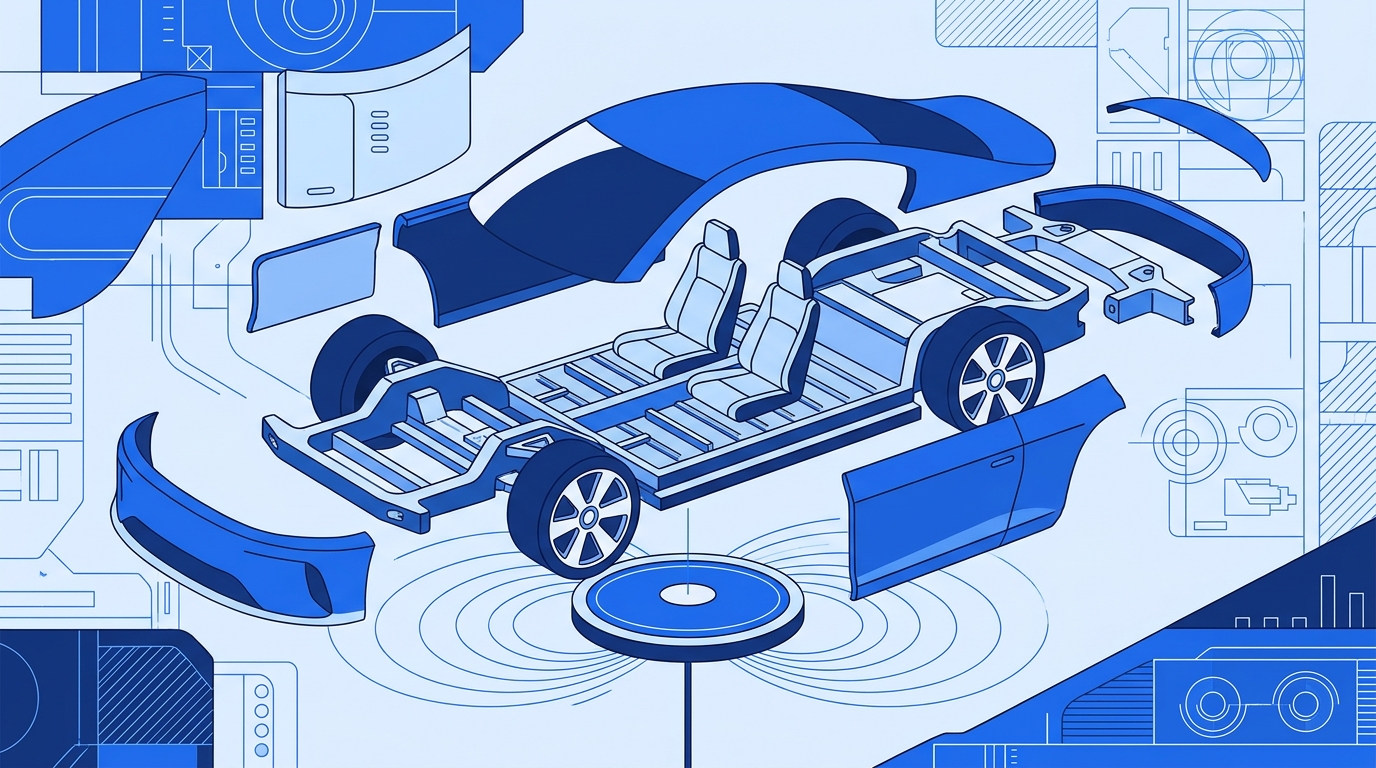
The concept sounds audacious. Build an electric vehicle in six parallel, modular sub-assemblies, paint each section independently, install the interior trim before the chassis ever meets the roof, and mate the whole puzzle together in a single rapid final step. If the math holds, Tesla claims this will slash factory footprints by over 40% and chop capital expenditures per vehicle nearly in half. But as someone who routinely tests consumer hardware, battery thermals, and real-world automotive build quality down to the fastener tolerances, I see massive engineering compromises that nobody is talking about.
Let's strip away the market cheerleading and look at the actual hardware, the thermodynamic math, and the brutal tolerance realities of building a $30,000 autonomous machine.
The 'Unboxed' Manufacturing Reality: Parallel Lines vs. Tolerance Stack-Up
To understand why this manufacturing shift matters, look at how cars have rolled off lines for the last 110 years. Ever since Henry Ford refined the moving assembly line in 1913, the automotive world has relied on a single snake-like conveyor. You weld a bare metal unibody skeleton, dip it into massive chemical and primer baths, run it through a paint shop, and then send workers inside a hollow metal cave to awkwardly install wiring harnesses, carpet, seats, and dashboards.
It is wildly inefficient. You spend immense factory space moving air inside a painted shell.
Tesla wants to smash that playbook with the unboxed model. Instead of one long line, you get parallel production zones:
- The Underbody Floor: The structural battery pack serves as the literal cabin floor, complete with the seats and center console bolted directly onto the battery lid before it touches the frame.
- Front and Rear Gigacastings: Massive high-pressure aluminum die-cast single pieces that carry suspension components and electric drive units, assembled completely outside the main vehicle body.
- Side and Roof Panels: Stamped, pre-finished exterior skins that receive their interior trim, glass, and sound deadening while flat on a workbench-style line.
On paper, assembly speed goes through the roof. Workers stand upright, robotic arms have direct line-of-sight access, and you eliminate the traditional paint shop bottleneck. But here is the elephant in the factory: tolerance stack-up.
Anyone who has spent five minutes inspecting a first-generation Model 3 or an early Cybertruck knows Tesla's historic struggle with panel gaps. In a traditional factory, if the steel body-in-white is off by 0.8 millimeters, panel beaters and automated robotic vision systems can shim or tweak doors and fenders before the vehicle leaves the body shop. In an unboxed process where pre-painted, pre-trimmed structural modules get glued and fastened together at the very end of the line, there is zero room to hide variance. A 0.5-millimeter drift on the front sub-frame combined with a 0.5-millimeter bow in the side panel creates an intolerable 1.0-millimeter misalignment at the shut line. You cannot hammer a finished module. If Tesla cannot hold micron-level precision across gigantic aluminum castings, these Cybercabs will roll off the line looking like mismatched puzzle pieces.
Wireless Induction Only: The Thermodynamic Tax of Dropping the Plug
Now let's examine the single most controversial hardware decision on the Cybercab: the complete omission of a physical charging port. No NACS connector. No CCS fallback. Just a giant inductive copper receiver coil mounted beneath the underbody belly pan.
Tesla's logic is clear: if a car has no human driver, there is nobody to grab a heavy charging cable and plug it into the rear quarter panel. Automated robotic plug arms—like the creepy snake charger Tesla showed off years ago—are mechanical nightmares packed with servos, optical sensors, and breakable gearboxes. Inductive charging pads on the asphalt eliminate moving parts. The car rolls over the pad, drops its air suspension, and charges wirelessly.
Convenient? Absolutely. Thermodynamic madness? Very possibly.
Basic physics does not care about silicon valley optimism. When you transfer 25 to 50 kilowatts of high-voltage direct current through an oscillating magnetic field across a 50-millimeter air gap, you pay an efficiency tax. Best-case industrial inductive systems achieve roughly 90% to 92% wall-to-battery efficiency under ideal alignment and pristine ambient temperatures. Compare that to a physical copper-to-copper NACS connection, which routinely hits 98% to 99% efficiency.
That missing 8% to 10% does not simply vanish. It turns into raw heat.
Do the math on a 35-kilowatt commercial charging pad. A 10% thermal loss means 3.5 kilowatts of heat dumping directly into the pavement and radiating straight up into the vehicle's bottom-mounted battery pack. In a climate-controlled test lab in Hawthorne, that is manageable. In Phoenix during an August heatwave where the asphalt is sitting at 145 degrees Fahrenheit, dumping an extra 3.5 kilowatts of parasitic heat into a lithium iron phosphate (LFP) pack is a recipe for thermal throttling and accelerated battery degradation. Unless Tesla equips both the ground pad and the Cybercab with high-flow active liquid cooling loops, the car will waste substantial energy just running air conditioning compressors to prevent its own battery cells from cooking while parked.
We publish our complete hardware teardowns and EV road-test telemetry over at Dev Dominion, where we track sensor degradation across different climates, and heat management consistently separates durable consumer hardware from fragile engineering demos.
Stripped Cabin Economics: What Does a $30,000 Robotaxi Actually Cost?
Tesla executives insist the Cybercab will launch with an MSRP under $30,000 for retail buyers and fleet operators alike. Can they hit that price tag without losing money on every unit? From a pure bill-of-materials (BOM) standpoint, I actually think the answer is yes. But consumers need to understand what has been ruthlessly deleted to get there.
Look at the hardware you are NOT paying for:
- No Driver Controls: Deleting the steering wheel, steering column, clockspring, mechanical pedals, pedal sensor arrays, and manual turn-signal stalks shaves hundreds of dollars in parts and assembly labor.
- No Mirrors or Actuators: Eliminating physical wing mirrors removes glass, motor assemblies, heating elements, and blind-spot indicator LEDs, while simultaneously cutting aerodynamic drag.
- A Tiny Battery Pack: Because the Cybercab is a lightweight two-seater with extreme aerodynamic efficiency (projected around 0.20 Cd), it doesn't need an expensive 80-kWh pack. An economical 40-kWh to 45-kWh LFP pack can easily yield 200 miles of urban range. That single decision cuts thousands out of the pack cost.
- 48-Volt Architecture: Following the Cybertruck's lead, the Cybercab uses a 48-volt low-voltage system rather than traditional 12-volt wiring. Thinner wires, smaller copper harnesses, and lighter controllers throughout the chassis.
The interior is Spartan. You get two bucket seats covered in easy-clean synthetic fabrics, a flat floor pan, dual wireless phone charging pads, and a single 15.4-inch display pulled straight from the existing Model 3 production line. There are no rear window regulators, no motorized tailgate hinges, and no complex dash structures. It is consumer hardware engineered with the cold, calculated efficiency of an airline cabin.
The Redundancy Paradox: Steer-by-Wire With No Mechanical Net
If you remove the physical steering shaft connecting your hands to the front wheels, your steer-by-wire system better have bulletproof redundancy. The Cybertruck pulled this off by packing dual electric steering rack motors, independent power feeds, and isolated controller units. But the Cybertruck still had a physical steering wheel in front of a licensed driver who could intervene if an error warning flashed on the dash.
On the Cybercab, there is no steering wheel to grab. None.
Achieving Automotive Safety Integrity Level D (ASIL-D) functional certification without a human override is a massive hurdle. Tesla must demonstrate that in the event of an electrical bus failure, compute crash, or actuator blowout, the vehicle can safely pull over without human intervention. That requires complete hardware duplication:
- Dual AI inference computers running parallel perception models.
- Dual independent battery isolation switches and redundant 48-volt wiring channels.
- Dual electronic braking actuators capable of emergency deceleration even if hydraulic pressure drops on primary lines.
Adding redundant microcontrollers, isolated wiring harnesses, and backup actuators costs real money. Every dollar saved by throwing out the steering wheel gets clawed right back by the safety redundancy hardware required to pass federal muster. Anyone who thinks an autonomous vehicle is cheaper to engineer than a standard manual car has never reviewed safety-critical hardware architectures.
The Regulatory Reality: FMVSS Exemptions Are Not Guaranteed
Even if the unboxed production line hums smoothly and the wireless charging pads dissipate heat without setting fire to fleet depots, Tesla still faces the brick wall of federal regulation. In the United States, the National Highway Traffic Safety Administration enforces the Federal Motor Vehicle Safety Standards (FMVSS). Part 571 mandates specific equipment on passenger vehicles: physical rear-view mirrors, manual brake controls, windshield defroster controls, and steering column impact criteria.
NHTSA does grant exemptions for autonomous test fleets, but current law caps those exemptions at 2,500 vehicles per manufacturer per year. You cannot run a commercial mass-market business producing hundreds of thousands of vehicles under a 2,500-unit exemption limit. Unless federal legislation updates FMVSS requirements to accommodate non-traditional vehicle designs, the Cybercab cannot be legally sold or registered by everyday consumers in the United States.
The Hardware Verdict: Skip the Robotaxi Hype, Watch the Platform
If you are an everyday car buyer holding off on purchasing an EV because you expect to order a $30,000 personal Cybercab next year, stop waiting. The regulatory timeline, federal crash testing certifications, and charging infrastructure build-out mean personal ownership of a cab without manual controls is still years away from broad reality.
However, if you are a tech and automotive hardware nerd like me, do not look away from this development. The Cybercab itself is an experimental vehicle, but the unboxed manufacturing architecture is the actual star of the show. If Tesla proves out modular sub-assemblies, structural seat-to-pack mounting, and parallel painting lines in Texas, that exact same manufacturing platform will underpin the long-awaited $25,000 compact hatchback—a car that will keep the steering wheel, keep the pedals, and utilize a standard charging port.
Tesla's unboxed method is either the biggest leap in automotive manufacturing efficiency since the moving conveyor, or a high-tolerance assembly disaster that will clog factory floors with misaligned modules. We will know the answer the moment the first production chassis rolls off the line.